Sales Training vs a Sales System
Sales Training vs a Sales System
Why One Works and One Doesn't Stick
The training day went well.
The team came back energised. There were good conversations on the way home about closing techniques, handling objections, reading buying signals. The trainer was sharp. The material was relevant. Everyone left with a folder of notes and a clear sense that something had shifted.
Three weeks later, you’d be hard-pressed to spot any difference in the numbers.
If that sounds familiar, you are not alone. It is the most common outcome of sales training investment — not because the training was poor, and not because the team didn’t take it seriously. But because training and a sales system are not versions of the same thing. They are fundamentally different interventions, with different shelf lives, different costs, and very different results.
Most businesses treat them as interchangeable. That confusion is expensive.
This article explains exactly what the difference is, why training alone almost never produces lasting change, and what a system looks like in practice — so you can assess which one your business actually needs.
What sales training does — and where it stops
To be clear from the outset: sales training is not worthless. Done well, it makes individuals better at the craft of selling. It teaches people how to open a conversation, handle an objection, read buying signals, ask for commitment. Those are real skills, and improving them has real value.
The problem is where that value ends.
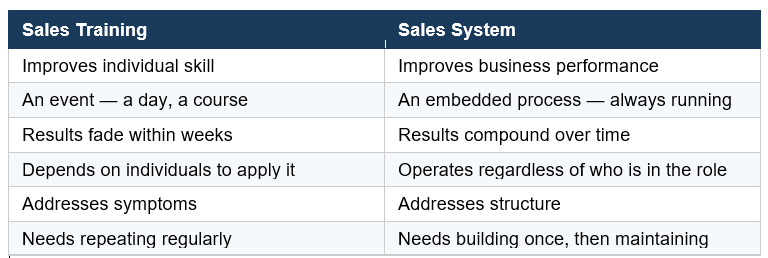
Training is an event. It takes place over a day, a weekend, or a series of sessions. Knowledge is transferred. Skills are practised in a controlled environment. People leave with good intentions, better technique, and a level of motivation they didn’t have when they arrived.
And then they return to an environment that is exactly the same as the one they left.
If the business has no consistent process for following up on enquiries, training doesn’t create one. If there’s no qualification standard, training doesn’t add one. If the pipeline is invisible to leadership, training doesn’t make it visible. If there’s no defined response time, no agreed next step framework, no structured sequence for moving a prospect from first contact to closed deal — training changes none of that.
Training changes what individuals know and, for a period, what they do. It does not change the system they are operating within.
And because the system doesn’t change, the results don’t change — not permanently. Motivation fades. Old habits reassert themselves. Within six to twelve weeks, the baseline is restored. Which is why most businesses that invest in sales training find themselves booking more training a year or two later, wondering why the first round didn’t hold.
Training changes what individuals know.
It does not change the system they are operating within. And if the system doesn’t change, the results don’t change — not permanently.
What a sales system is — and why it works differently
A sales system is the set of structured processes that govern how sales activity happens in a business — regardless of who is doing it on any given day.
It defines how enquiries are received and responded to. How prospects are qualified. How the pipeline is managed. How follow-up happens. How proposals are made. How performance is measured. And what the next step is at every stage of the journey from first contact to closed deal.
The critical distinction is in that last phrase: regardless of who is doing it. A system doesn’t depend on individual memory, individual motivation, or individual talent. It operates because the process is defined, documented, and embedded into how the business runs.
Consider the difference in practice.
In a business with a sales system, a new member of the sales team knows from day one exactly what to do when an enquiry arrives. They know the response time standard. They know the qualification questions to ask. They know the follow-up sequence and the purpose of each contact. They know how to record the opportunity and what stage it moves to after each interaction. They don’t have to improvise. They don’t have to watch a colleague to understand the unwritten rules. The process tells them.
In a business without one, every person does it slightly differently. Every day is slightly different. Some enquiries are followed up diligently. Others disappear into an inbox. Some deals are progressed with structure and purpose. Others drift without a clear next step. The results are inconsistent — not because the people are inconsistent in character, but because the process is inconsistent by design.
The system is what makes performance predictable. Without it, performance depends on people — and people, however talented, are variable.
Why businesses keep investing in training — and not getting the results they expect
This isn’t a criticism of the businesses that fall into this pattern. It’s an entirely rational response to the information available. There are three reasons why training is the default intervention, and each of them makes sense in isolation.
It’s visible and easy to act on
A training day is easy to buy, easy to schedule, and easy to point to. It produces a clear sense of progress: “We invested in the team.” There’s a date, a provider, an invoice, and a room full of people doing something purposeful.
A sales system takes longer to build. The results emerge over weeks rather than days. It feels like infrastructure — unglamorous, slow, necessary. Training feels like action. Systems feel like admin. So when the pressure is on and results need to improve, training wins the argument almost every time.
It addresses the visible symptom
When a deal doesn’t close, the natural assumption is that someone didn’t sell well enough. The conversation wasn’t confident enough. The objection wasn’t handled well. The close wasn’t committed enough. So the intervention is to teach people to sell better.
But in most cases, the deal didn’t close because of process failures that would have undermined any individual’s performance. The response was too slow. There was no structured follow-up. The prospect was never properly qualified. The conversation ended without an agreed next step. No amount of closing technique fixes those failures — because the failures happened before the conversation even reached that point.
Training addresses what people do in the room. It doesn’t address what happens before they get there, or after they leave.
The improvement is real — just temporary
This is the most seductive part of the trap. Training genuinely works in the short term. Motivation increases. Technique improves. The team has better conversations and the numbers nudge upward. It creates the impression that the investment worked.
And then, over the following months, as the motivation fades and the old environment reasserts its gravity, performance returns to baseline. By the time it’s obvious that the gain has been lost, the organisation has moved on to the next priority — and the cycle begins again twelve months later.
The training trap isn’t a failure of intelligence.
It’s a failure of diagnosis. The symptom is low conversion. The diagnosis is “people need to sell better.” The correct diagnosis, in most cases, is “the process needs to be built.”
What confusing the two actually costs
This distinction isn’t academic. The cost of getting it wrong shows up in three places.
The direct cost of repeated training
Sales training at a credible level is not cheap. And because it needs to be repeated to maintain even its short-term effect — the knowledge fades, the motivation resets, a new team member joins and needs the same input — it becomes a recurring cost with a diminishing return. If the underlying system isn’t in place, you are generating temporary uplift at permanent expense.
The opportunity cost of lost conversions
Consider a business receiving 40 enquiries a month. If the current conversion rate is 15%, that’s 6 clients. If a well-structured process produces a conversion rate of 25%, that’s 10 clients. The difference — 4 additional clients per month — represents a very large number over the course of a year, at the typical revenue values of businesses in this space.
That revenue was available. The enquiries arrived. The demand existed. The absence of a structured process is what meant it wasn’t captured. That is the real cost of the gap between training and system.
The cost to the team
A sales team operating without clear process carries a hidden burden. Every day, they have to make judgements that a system would make for them — when to follow up, what to say, how to prioritise, where to focus. That cognitive load is real. It produces decision fatigue, inconsistency, and — over time — disengagement. The best salespeople eventually leave for environments where the process supports their effort rather than competing with it.
Training has its place — but sequence matters
To be clear: this is not an argument that training is worthless. It is an argument about order.
The businesses that get the most out of sales training are the ones that already have the infrastructure in place. When the process is defined — when there is a clear follow-up sequence, a qualification standard, a pipeline structure, a defined response time — training can genuinely amplify it. You are teaching people to perform better within a framework that will hold what they learn. The environment reinforces the skill rather than eroding it.
Training before system is teaching people to swim without giving them a pool. The skill is real. There’s nowhere consistent to use it.
Build the system first. Then use training to raise the performance ceiling within it.
If your business is considering sales training, the first question to ask is not “Which provider?”
It is: “Do we have the system that will let this training stick?”
If the answer is no, the training spend is at risk before it’s committed.
What a sales system looks like in practice
A system doesn’t need to be complex. The businesses that perform most consistently don’t have elaborate CRM setups or 40-step sales processes. They have five things, built well and maintained consistently.
•An enquiry response standard. Every enquiry has a maximum response time — written down, assigned to a role, and measured. Not a guideline. A standard. In most high-performing businesses, this sits at under two hours during business hours.
•A qualification framework. A consistent set of questions asked at first contact that establishes fit, urgency, and decision-making authority. The same questions, every time, by every person who handles an initial enquiry. This is not an interrogation — it’s a structured conversation that shapes everything that follows.
•A follow-up sequence. A defined number of contacts, at defined intervals, with a defined purpose for each one. Written down, agreed, and used consistently. Not left to individual memory or initiative. The sequence is the same whether it’s a Monday morning or a Friday afternoon.
•A visible pipeline. A live record of every active opportunity: its stage, its last contact date, its next action, and who is responsible for it. Available to leadership at any point — not reconstructed from memory at the end of the month when the numbers are already in.
•A measurement framework. Defined metrics reviewed regularly. Not just revenue, but leading indicators: number of enquiries, response rates, conversion at each stage, average time from enquiry to close. So the business can see where performance is being lost before it shows up in the monthly figures.
Most of this is not complicated. What makes it hard is building the discipline to install it — particularly in businesses where the culture has been built around individual effort and improvisation rather than shared process. That transition takes time and, usually, external challenge to make it happen.
But once it’s in place, performance stops depending on whether the right person had a good week.
The question worth asking before you book the next training day
Training improves individuals. Systems improve businesses. Both have a role — but not in that order, and not as substitutes for each other.
If your conversion rate is lower than it should be, if revenue feels unpredictable, if the pipeline is difficult to read — the answer is almost certainly process, not skill. More training will produce the same short-term lift and the same medium-term return to baseline.
Build the system first. Then invest in training to raise the ceiling within it. That is the sequence that produces lasting commercial improvement.
Find out where your sales system has gaps
The Sales Success Score takes three minutes. It shows you exactly where your process is under-performing and what to focus on first — before you spend another penny on training.
If you’d prefer to talk through what building a sales system looks like for your specific business, you can book a Sales Strategy Review with David — a structured conversation about where your process currently sits and what a stronger version looks like.
David Standing is a sales systems and profit improvement consultant working with commercial businesses turning £3M to £30M. He founded Accordant Partners to install the revenue infrastructure that makes growth predictable. Find out more about working with David.